K2‑SPRING Q-ENERGY Innovator Unit グリーンイノベーションユニット
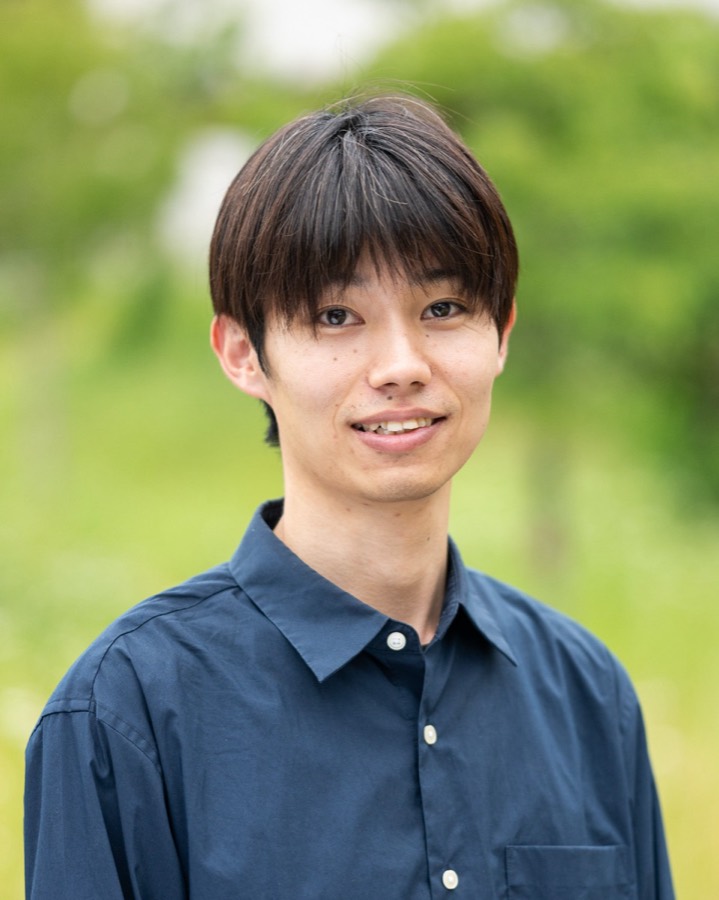
Takeshi Mochizuki Photo
mochizuki_takeshi.jpg
2026 Cohort 2026年度
K2-SPRING · Q-ENERGY Innovator Unit · Admission 2026 K2-SPRING · グリーンイノベーションユニット · 2026年度入学

Takeshi Mochizuki

望月 建志

Affiliation
所属
Interdisciplinary Graduate School of Engineering Sciences
総合理工学府
Major / Department
専攻
Interdisciplinary Engineering Sciences
総合理工学専攻
Supervisor
指導教員
Prof. Takahiko MIYAZAKI 宮崎 隆彦 教授
§ 01

K2-SPRING research

K2-SPRING 研究

K2-SPRING Project · Primary focus K2-SPRINGプロジェクト · 主題

Elucidation of Heat Transfer Enhancement Mechanisms in Flow Boiling via Thermo-Informatics

サーモインフォマティクスによる流動沸騰現象の伝熱促進メカニズム解明

Thermo-informatics is an emerging research field that integrates thermal engineering with informatics. Specifically, this research combines experimental approaches with machine learning to systematize the mechanisms of heat-transfer enhancement in in-tube flow-boiling phenomena. This approach is expected to lead to foundational technologies for optimizing heat transport and designing high-performance heat exchangers.
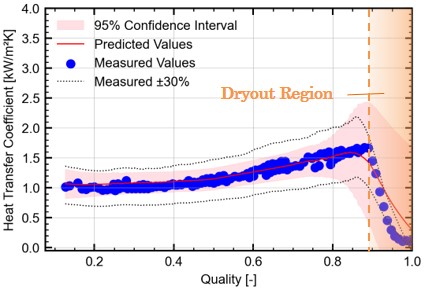
Predicted and measured boiling heat transfer coefficient versus vapor quality, with the dryout region indicated
Fig. Predicted boiling heat transfer coefficient from the ML model

In flow boiling, where vapor and liquid flow in a complex manner, the “thinness” and “distribution” of the liquid film — driven by convective effects — are considered the keys to enhancing heat transfer. Therefore, this study attempts to elucidate the interactions of the dynamic factors inherent in boiling phenomena, such as surface tension, gravity, and inertial forces, by utilizing machine learning. The introduction of machine learning enables various experimental data (explanatory variables) to be deeply correlated with these dynamic factors, thereby allowing for a highly sophisticated and detailed analysis of the underlying physical mechanisms. As shown in the figure, it has been demonstrated that it is now possible to predict non-linear heat-transfer variations, particularly in the dryout region, which have traditionally been difficult to predict using conventional empirical correlations.

Moving forward, the aim is to further enhance the versatility and reliability of the machine-learning models. Through the advanced harmonization of thermal engineering and informatics, this research will contribute to the realization of a sustainable society.

「サーモインフォマティクス」とは、熱を扱う「熱工学」と、データを扱う「情報工学」を融合させた新しい研究領域です。本研究では、特に、「実験」と「機械学習」を掛け合わせ、管内の流動沸騰現象における伝熱促進メカニズムの体系化を目指しています。

本研究アプローチは、熱輸送を最適化し、高性能な熱交換器を設計するための基盤技術の創出に繋がると考えています。
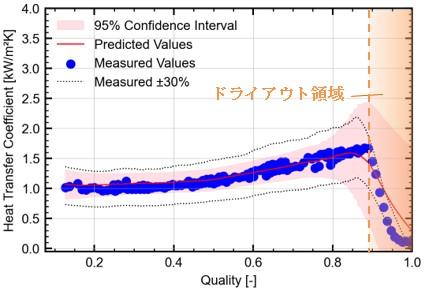
機械学習モデルによる沸騰熱伝達率の予測(測定値・予測値とドライアウト領域)
Fig. 機械学習モデルによる沸騰熱伝達率の予測

気体と液体が複雑に混ざり合って流れる流動沸騰においては、対流の効果によって生じる「液膜の薄さ」や「その分布」が、伝熱促進の鍵とされています。そこで、沸騰現象に内在する力学的な要因(表面張力・重力・慣性力など)の相互作用を、機械学習を用いて明らかにしていくことが本研究の試みです。機械学習の導入は、さまざまな実験データ(説明変数)と力学的な要因を深く紐づけることができ、物理メカニズムをより高度かつ詳細に分析することが可能となります。図が示すように従来の整理式では予測が難しかった非線形な伝熱変化(ドライアウト領域)においても、予測可能であることが分かってきました。

今後は、さらに機械学習モデルの汎用性と信頼性を高め、「熱工学×情報工学」の高度な調和から持続可能な社会の実現に貢献いたします。

§ 02

Doctoral research — context for the K2-SPRING project

博士 研究 — K2-SPRINGプロジェクトの背景

Main PhD work 博士課程主研究

Study of Heat Transfer Mechanisms in Vapor-Liquid Two-Phase Flow via Thermo-Informatics

サーモインフォマティクスによる気液二相流伝熱メカニズムの研究

In the HVAC&R field, a transition to alternative refrigerants responsible for heat transport is required. Although this initiative is essential for reducing environmental impact, immediate changes are difficult due to the high penetration rate of air conditioners and high thermal demand, necessitating a phased transition. As a phased strategy, “non-azeotropic refrigerant mixtures” — which blend conventional refrigerants with low-environmental-impact next-generation refrigerants — are currently being developed and evaluated. However, differing boiling points among the constituent refrigerants give rise to a unique thermal characteristic known as “temperature glide,” which presents a technical barrier to the practical application of these new refrigerants.

To address this challenge, this doctoral research performs boiling and condensation experiments using these new refrigerants to clarify their heat-transfer characteristics (vapor-liquid two-phase-flow heat-transfer mechanisms). This study focuses primarily on experimental approaches to expand knowledge regarding new refrigerants. At the same time, applying machine learning to analyze the acquired data enables a deep understanding of both the visible data trends and the underlying physical mechanisms. Through this research, the technical barrier of temperature glide will be overcome, contributing to design and operational guidelines that support a smooth transition to next-generation refrigerants in harmony with the global environment.

エアコンをはじめとする冷凍空調分野では、熱輸送を担う冷媒の転換が求められています。環境負荷軽減のために必要な取り組みですが、エアコンなどの普及率および熱需要の高さから、急激な変更は難しく、段階的な転換が必要になります。段階的な策として従来の冷媒と環境負荷の低い次世代冷媒を混ぜ合わせた冷媒「非共沸混合冷媒」が開発・検討されています。しかし、冷媒の沸点が異なるため「温度グライド」と呼ばれる特有の熱的特性が生じ、新規冷媒を実用化する上での技術的障壁となっています。そこで、博士課程の研究では、この新規冷媒を用いた沸騰・凝縮実験を行い、伝熱特性(気液二相流伝熱メカニズム)を明らかにします。本研究は、実験を中心に進め新規冷媒に関する知見を増やすと同時に、取得データの分析に機械学習を活用することで、データが示す傾向から背後にある物理メカニズムまで深く解き明かしていきます。本研究を通じて、温度グライドという技術障壁を克服し、地球環境と調和する次世代冷媒へのスムーズな移行を支える設計・運用指針の構築に貢献いたします。

§ 03

Research achievements

研究 成果

Research Papers論文
  1. Lilian Aketch Okwiri, Takeshi Mochizuki, Kairi Koito, Noriaki Fukui, Koji Enoki “Enhanced Pool Boiling via Binder Jetting 3D-Printed Porous Copper Structures: CHF and HTC Investigation” Applied Sciences, Vol. 15, 7892 (2025) — 10.3390/app15147892
  2. Tomihiro Kinjo, Takeshi Mochizuki, Hayato Nakano, Koji Enoki, Yuichi Sei “Machine-Learning and Experimental Study on Predicting the Heat Transfer Coefficient in Vertical and Microgravity Flow Boiling Using Horizontal Flow Data” Journal of Thermal Science and Engineering Applications, Vol. 76, TSEA-25-1724 (2026) — 10.1115/1.4071502
  3. Takeshi Mochizuki, Kosaku Nishida, Ikuro Akada, Hiroya Mamori, Koji Enoki “Experimental Study of Flow Boiling Characteristics in Wavy-Shaped Mini-channel” Applied Thermal Engineering, manuscript no. ATE-D-26-04350R1 [Under Review]
Conference Presentations学会発表
  1. Takeshi Mochizuki, Kosaku Nishida, Ikuro Akada, Takafumi Ouchi, Koji Enoki “Experimental Study of Flow Boiling Characteristics in Wavy-Shaped Mini-Channel” The Third Pacific Rim Thermal Engineering Conference (2024/12) [International, Oral]
  2. Takeshi Mochizuki, Kosaku Nishida, Ikuro Akada, Takafumi Ouchi, Koji Enoki “Experimental Study of Flow Boiling Characteristics in Wavy-Shaped Mini-Channel” 35th International Symposium on Transport Phenomena (2025/09) [International, Oral]
  3. Takeshi Mochizuki, Yuma Koriki, Hiroya Mamori, Wang Menglei, Takeshi Miyazaki “Heat Transfer Enhancement by Traveling Wave Control in Turbulent Channel Flow” The 9th Asian Pacific Congress on Computational Mechanics & 7th Australasian Conference on Computational Mechanics (2025/12) [International, Oral]
  4. 望月 建志、西田 耕作、赤田 郁朗、榎木 光治 「金属焼結繊維状多孔質体を用いた車載用空冷熱交換器の空気側の伝熱試験」 日本冷凍空調学会 (2023/09) [国内,口頭発表]
  5. 望月 建志、西田 耕作、赤田 郁朗、榎木 光治 「連結流路を用いた並列多孔微細流路における油混合冷媒の流動特性」 日本冷凍空調学会 (2024/09) [国内,口頭発表]
  6. 望月 建志、西田 耕作、赤田 郁朗、榎木 光治 「波状形状を有する微細管内における流動沸騰特性」 日本冷凍空調学会 (2025/09) [国内,口頭発表]
Other Achievementsその他の業績
  1. Student Commendation Award (学生表彰) — University of Electro-Communications (2025/03)
  2. Student Commendation Award (学生表彰) — University of Electro-Communications (2026/03)
Programme & institutional affiliation プログラム・機関情報
K2-SPRING JST SPRING programmeJSTスプリングプログラム
Q-PIT Unit coordinatorユニットコーディネーター
Q-Energy Innovator Unit Q-Energy Innovator Unitグリーンイノベーションユニット
Kyushu University Host universityホスト大学