K2‑SPRING Q-ENERGY Innovator Unit グリーンイノベーションユニット
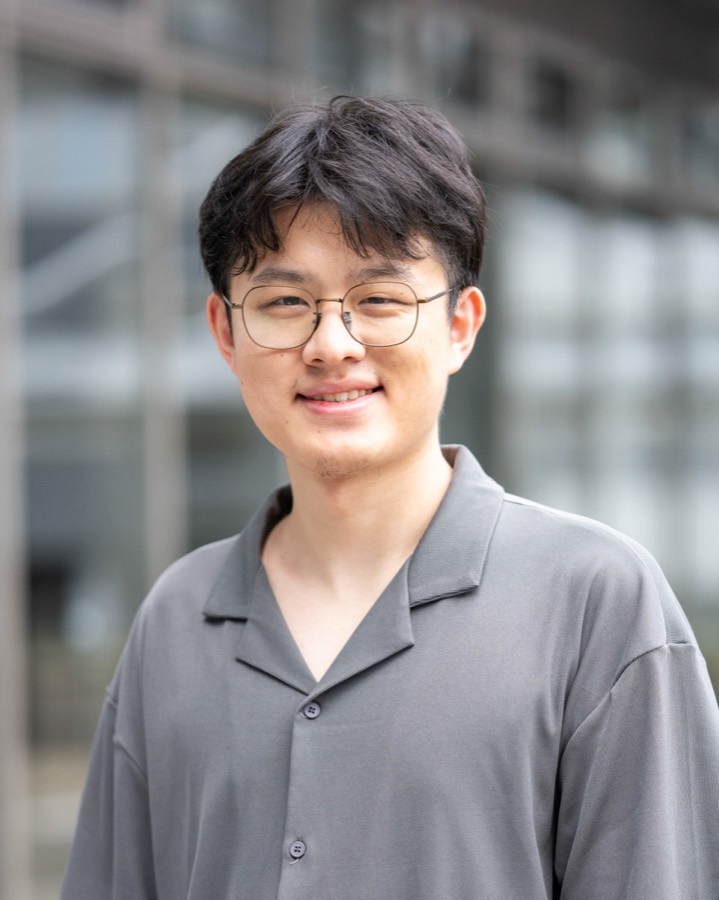
Ziqi Jiang Photo
jiang_ziqi.jpg
2026 Cohort 2026年度
K2-SPRING · Q-ENERGY Innovator Unit · Admission 2026 K2-SPRING · グリーンイノベーションユニット · 2026年度入学

Ziqi Jiang

Ziqi Jiang

Affiliation
所属
Interdisciplinary Graduate School of Engineering Sciences
総合理工学府
Major / Department
専攻
Mechanical and Systems Engineering
機械システム工学専攻
Supervisor
指導教員
Prof. Kyaw THU Kyaw Thu 教授
§ 01

K2-SPRING research

K2-SPRING 研究

K2-SPRING Project · Primary focus K2-SPRINGプロジェクト · 主題

Molecular Dynamics Investigation of Li-ion Transport Properties in Battery Electrolytes

Molecular Dynamics Investigation of Li-ion Transport Properties in Battery Electrolytes

Macro-scale battery models often rely on empirical electrolyte transport parameters, which limits their predictive capability under practical operating conditions such as fast charging, low temperature, high salt concentration, and long-term aging. This K2-SPRING project addresses this limitation by using molecular dynamics (MD) and density functional theory (DFT) calculations to investigate Li-ion transport mechanisms in liquid electrolytes at the molecular scale. The work focuses on how salt concentration, temperature, solvent composition, solvation structure, and ion-pair formation influence key electrolyte properties, including Li-ion diffusivity, viscosity, dielectric response, coordination number, and local ion–solvent interactions. These molecular-scale properties are then used to provide physics-based, condition-dependent transport parameters for macroscopic electrochemical models, supporting more reliable state-of-health prediction and safer battery-management-system design.
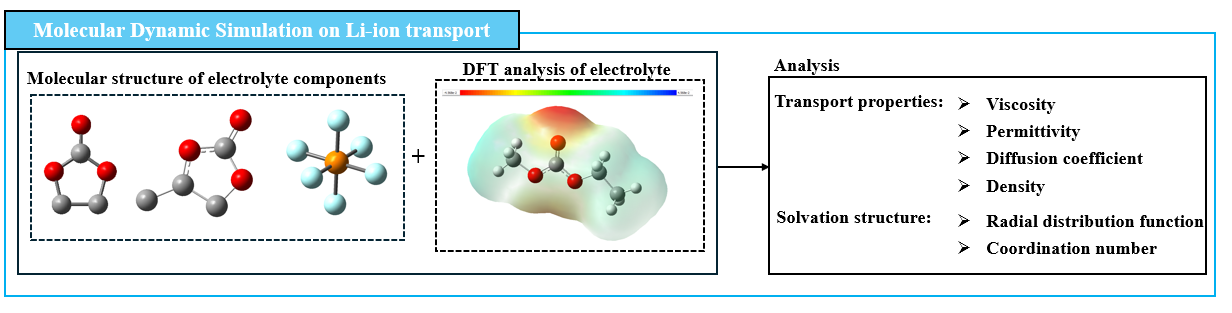
Schematic: molecular structures of electrolyte components and DFT analysis of an electrolyte feeding transport-property and solvation-structure analysis for Li-ion transport
Fig. Molecular dynamics and DFT workflow for Li-ion transport properties in battery electrolytes

Macro-scale battery models often rely on empirical electrolyte transport parameters, which limits their predictive capability under practical operating conditions such as fast charging, low temperature, high salt concentration, and long-term aging. This K2-SPRING project addresses this limitation by using molecular dynamics (MD) and density functional theory (DFT) calculations to investigate Li-ion transport mechanisms in liquid electrolytes at the molecular scale. The work focuses on how salt concentration, temperature, solvent composition, solvation structure, and ion-pair formation influence key electrolyte properties, including Li-ion diffusivity, viscosity, dielectric response, coordination number, and local ion–solvent interactions. These molecular-scale properties are then used to provide physics-based, condition-dependent transport parameters for macroscopic electrochemical models, supporting more reliable state-of-health prediction and safer battery-management-system design.


Schematic: molecular structures of electrolyte components and DFT analysis of an electrolyte feeding transport-property and solvation-structure analysis for Li-ion transport
Fig. Molecular dynamics and DFT workflow for Li-ion transport properties in battery electrolytes
§ 02

Doctoral research — context for the K2-SPRING project

博士 研究 — K2-SPRINGプロジェクトの背景

Main PhD work 博士課程主研究

Multi-scale modeling of battery degradation from electrolyte transport to state-of-health prediction

Multi-scale modeling of battery degradation from electrolyte transport to state-of-health prediction

This project uses molecular dynamics (MD) and density functional theory (DFT) simulations to investigate Li-ion transport properties in battery electrolytes under different salt concentrations, temperatures, and solvent environments. The work extracts molecular-level properties such as diffusivity, viscosity, dielectric response, solvation structure, coordination number, and ion-pair formation, which are difficult to represent using empirical parameters alone. These condition-dependent transport properties are then linked to macroscopic pseudo-two-dimensional (P2D) electrochemical–thermal aging models. By connecting molecular electrolyte behavior with battery-level degradation modeling, this research aims to improve state-of-health prediction, thermal-safety assessment, and battery-management-system reliability for long-life lithium-ion batteries.

This project uses molecular dynamics (MD) and density functional theory (DFT) simulations to investigate Li-ion transport properties in battery electrolytes under different salt concentrations, temperatures, and solvent environments. The work extracts molecular-level properties such as diffusivity, viscosity, dielectric response, solvation structure, coordination number, and ion-pair formation, which are difficult to represent using empirical parameters alone. These condition-dependent transport properties are then linked to macroscopic pseudo-two-dimensional (P2D) electrochemical–thermal aging models. By connecting molecular electrolyte behavior with battery-level degradation modeling, this research aims to improve state-of-health prediction, thermal-safety assessment, and battery-management-system reliability for long-life lithium-ion batteries.

§ 03

Research achievements

研究 成果

Research Papers論文
  1. Jiang Z, Itamoto R, Lin J, Mikšík F, Miyazaki T, Kim Y-D, Thu K. “Lithium-ion battery aging: An integrated review of mechanisms, multi-scale modelling, and physics-informed health prediction” Renewable and Sustainable Energy Reviews, Vol. 244, 117458 (2027) doi:10.1016/j.rser.2026.117458
  2. Jiang Z, Itamoto R, Nagase T, Lin J, Tian Y, Miyazaki T, Kim Y-D, Thu K. “Thermal management and cycle life enhancement of Lithium-ion Battery packs using low-fin tubes: Electrochemical-thermal-aging modelling and geometric optimization” Journal of Energy Storage, Vol. 181, 124527 (2026) doi:10.1016/j.est.2026.124527
  3. Jiang Z, Tian Y, Li K, Zhao Z, Liu N, Zhang H. “Research on refrigerant charge determination under different compressor speed and its effects on the performance of transcritical CO2 air-conditioning heat pump system in electric vehicle” Energy, Vol. 296, 131192 (2024)
  4. Jiang Z, Li M, Liu Z, Tian Y, Li K, Liu N, et al. “Performance analysis and thermal comfort evaluation of a CO2 transcritical air-conditioning system for cabin thermal management of electric vehicles” Journal of Cleaner Production, Vol. 479, 144023 (2024)
  5. Tian Y, Wang Z, Liu Z, Jiang Z. “Two-phase flow characteristics and leakage in the shaft seal of steam screw expanders” International Journal of Refrigeration, Vol. 172, pp. 214–227 (2025)
  6. Tian Y, Liu Z, Xia Y, Jiang Z, Li K, Liu N, Zhang H. “Investigation on the flow characteristics through different discharge port in scroll compressor for electric vehicles” International Journal of Refrigeration, Vol. 168, pp. 135–148 (2024)
  7. Xia Y, Jiang Z, Zhang B, et al. “Numerical investigation on characteristics of vapor injection of a scroll compressor for electric vehicle” Journal of Refrigeration, Vol. 45, No. 4, pp. 131–149 (2024)
  8. Xia Y, Jin G, Shi Y, Jiang Z, et al. “Study on the flow characteristics of discharge port of a scroll compressor” Fluid Machinery, Vol. 52, No. 7, pp. 15–23 (2024)
Conference Presentations学会発表
  1. Jiang Z, Wang Z, Liu Z, et al. “Study on Refrigerant Charge Determination of a Transcritical CO2 Air-Conditioning Heat Pump System in Electric Vehicle” International Symposium on Advanced Mechanical & Power Engineering (ISAPE), University of Malaysia Sabah (2024/12) [International, Oral]
  2. Wang Z, Liu Z, Jiang Z, et al. “Two-phase flow characteristics and leakage in the shaft seal of steam screw expanders” 2024 Academic Conference on Engineering Thermodynamics and Energy Utilization, Chinese Society of Engineering Thermophysics, Xiamen, China (2024/12) [Domestic, Oral]
  3. Jiang Z, Itamoto R, Lin J, et al. “Effects of LiPF6 Salt on Transport Properties of Liquid Ethylene Carbonate Electrolytes: A Molecular Dynamics Study” The 12th Asian Conference on Refrigeration and Air-conditioning (ACRA 2026), Taichung, Taiwan (2026/05) [International Oral]
Other Achievementsその他の業績
  1. Best Presenter Award — International Symposium on Advanced Mechanical & Power Engineering (ISAPE) (2024/12)
  2. Shanghai Excellent Master Graduate — University of Shanghai for Science and Technology (2025)
  3. 3rd Prize — National English Competition (2023)
  4. Patent: “A coupling system of natural gas differential pressure power generation and air source heat pump” CN202310038598.2 (Shanghai, 2023)
Programme & institutional affiliation プログラム・機関情報
K2-SPRING JST SPRING programmeJSTスプリングプログラム
Q-PIT Unit coordinatorユニットコーディネーター
Q-Energy Innovator Unit Q-Energy Innovator Unitグリーンイノベーションユニット
Kyushu University Host universityホスト大学